Press Release
January 22, 2026
Mozilla Foundation releases Imagine Intel, a new zine on ‘Creative Purpose at the Dawn of AI’
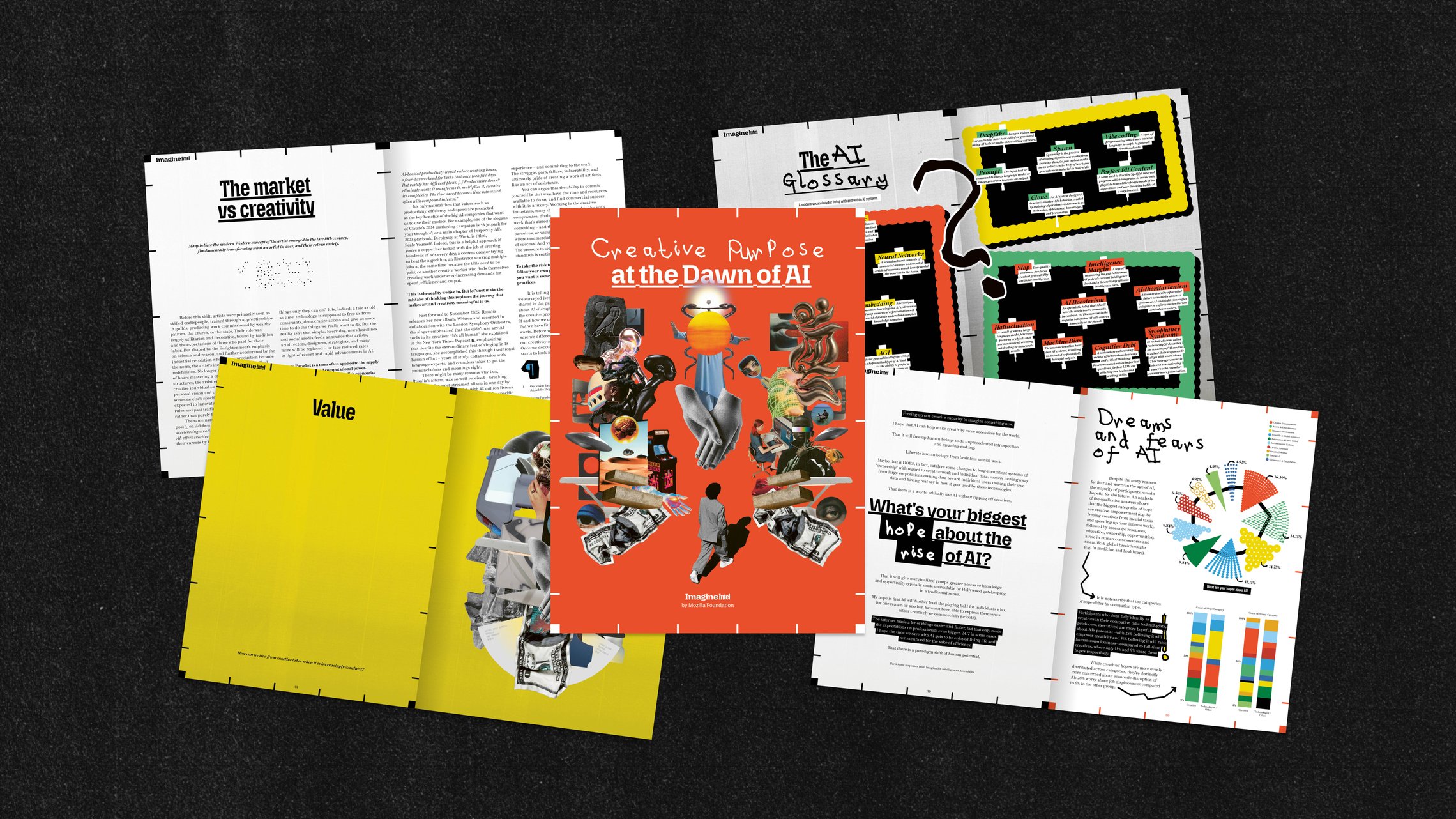
The zine aims to equip artists and creatives with agency to navigate AI on their own terms
LOS ANGELES, THURSDAY JANUARY 22, 2026 - Today, Mozilla Foundation announces the publication of Imagine Intel: Creative Purpose at the Dawn of AI, a new zine capturing the hopes, anxieties, and demands of creatives working at a transformational moment for creativity and technology.
Drawn from Mozilla Foundation and the Berggruen Institute’s 2025 Imaginative Intelligences Assemblies — an experimental, artist-led methodology for collective inquiry — the publication offers one of the first qualitative portraits of how creative workers in Los Angeles and Hollywood are navigating the rapidly shifting AI landscape.
The zine was created with a community-first editorial approach, much like the Assemblies themselves, and puts it in a global creative context. It takes the original insights and data from real, working creative people and presents it alongside curated cultural examples, original artwork by Dakarai Akil, a Los Angeles based collage artist, remixed for the reader’s delight with best-in-class editorial design.
The Assemblies’ work is led by Mozilla Foundation’s Creative Futures program, which focuses on people-first approaches to emerging technology and develops cultural infrastructure that places creators — not platforms — at the center of digital life.
As Executive Director Nabiha Syed writes in the zine’s foreword, “While others race to automate creativity, Mozilla Foundation is demonstrating that human imagination cannot be replaced.”
At its core, Imagine Intel argues that we can choose differently when it comes to AI’s role in culture and in people’s lives. Rather than accepting narratives that frame automation as inevitable, the zine demonstrates the possibility of creative futures shaped by communities, not corporations.
In this spirit, creative workers can choose how they wish to interact with AI, and this zine looks to equip them with the knowledge and context to be able to do just that, while seeing AI as it stands today for what it really is. As one Assembly participant put it, “AI is aggregated human intelligence. It’s collective — not artificial.”
Imagine Intel: Creative Purpose at the Dawn of AI is available today as a free digital zine on the Mozilla Foundation website, with an accompanying content takeover on Nothing Personal, Mozilla Foundation’s new editorial platform for independent thinkers, technologists, and creatives on the front lines of digital culture.
About Imagine Intel
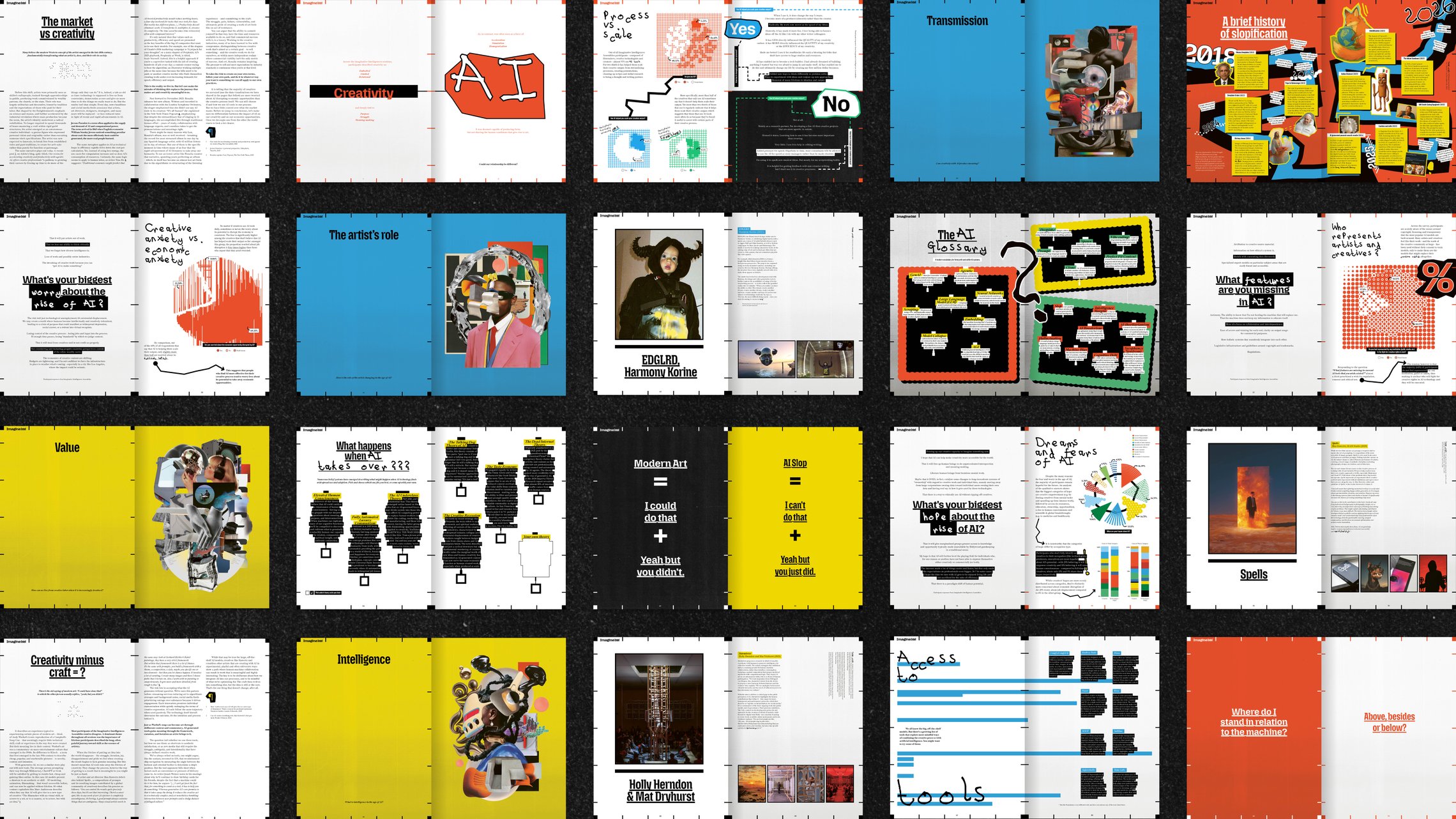
Imagine Intel is the zine published by Mozilla Foundation to accompany the Imaginative Intelligences Assemblies project, delivered as part of the Foundation’s Creative Futures program in partnership with Berggruen Institute. This cultural artifact aims to document, distribute and play with the results of the unique collective experiment that was started in early 2025 in Los Angeles.
It accompanies the original Assemblies research report, and is tailored for the creative worker to empower them with agency and knowledge in an era of accelerated technological change.
Physical copies (limited run of 500) were printed by PARK Press in the UK. The limited edition zine is commissioned by Mozilla Foundation, featuring original artwork by LA based collage artist Dakarai Akil, and produced in collaboration with Severin Matusek, Günseli Yalcinkaya, Alice Smith of co–matter, the Berlin-based global research and strategy studio.
About the Imaginative Intelligences Assemblies
The Imaginative Intelligences Assemblies, hosted by Mozilla Foundation and the Berggruen Institute in early 2025, brought together 91 creatives, technologists, and thinkers to ask: What is creative purpose in the age of AI?
Across five half-day sessions (12–20 people each), 91 participants from across the creative industries – filmmakers, producers, animators, performers, musicians, composers, technologists, academics, content creators, and storytellers – engaged in facilitated dialogue and hands-on modeling using the Creative Assembly approach, led by Gabriel Kahan.
The Creative Assembly is a 6-hour participatory, interactive cultural technology that enables diverse groups of people from varied backgrounds and abilities to identify, metabolize and express common yet complex situations through narrative thinking, deep listening, design management and manufacturing, and artistic visualization.
The resultant report documents the Assemblies in detail, including its methods, themes, and cross-cutting insights. The report underscores a simple truth: AI is being built faster than many of us can make sense of—and too often without the input of the people whose livelihoods it threatens. The report distills the insights of the Hollywood creative industries into key statistics and stories highlighting both risks and opportunities as AI reshapes the future of culture. It also proposes 8 Rules as a call to action for building technology that strengthens, rather than erodes, human creativity. Key themes that emerged from the research process included:
The conflicting natures of AI and creativity
- AI accelerates but flattens: AI speeds up creative output but strips away the struggle and discovery that give art depth.
- Simulation ≠ experience: AI can mimic form, but it can’t create from lived memory, pain, or joy.
- AI disrupts value itself: If creation is instant and cheap, what makes it meaningful or worth paying for?
- Friction matters: Speed and convenience are not always good. Struggle, limits, and slow time build meaning.
The impact of AI on the industry
- Artists are shifting roles: More curators, editors, and system designers than original makers.
- Creative labor is under threat: Creative work is increasingly precarious, and most artists feel unrepresented in tech debates.
The way forward
- Systemic design is key: AI is an infrastructure that can either homogenize culture or amplify difference.
- Resistance means redesign: The creative community doesn’t reject AI but wants it rebuilt around human purpose.
The Imaginative Intelligences report, including Hollywood’s 8 Rules for AI, is a call to action for policymakers, funders, and technologists to ensure AI strengthens, rather than undermines, human imagination and livelihoods.
When making policy around AI this report challenges policymakers, platform owners and industry to think beyond copyright — rules for AI should center on human purpose, sustainable ecosystems, and collective benefit. The ask is not to cease using AI entirely, but to rebuild it with creative process preservation.
About Mozilla Foundation
Mozilla Foundation is a global nonprofit dedicated to ensuring the internet remains open, inclusive, and equitable. Founded in 2003, it supports people-first technology through funding, advocacy, education, and research. Rooted in the open-source movement and guided by the Mozilla Manifesto, Mozilla Foundation focuses on critical issue areas like ethical data practices, healthy digital ecosystems and shifting digital power toward individuals and communities. Its work connects technologists, researchers, policymakers, and activists to reimagine and rebuild systems to serve the public good. With over two decades of global impact, Mozilla Foundation continues to lead the movement for a better technology future—powered by people, open by design and fueled by imagination.