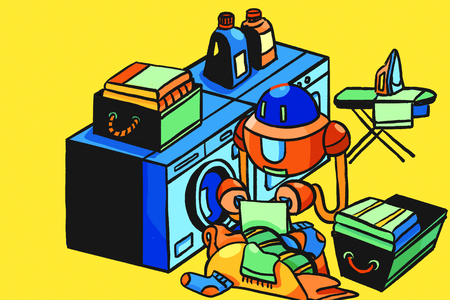
Folding laundry is a waste of human time. On this, you, your spouse, and I agree.
Right now, a human with a smartphone strapped to their forehead is being paid up to $25 per hour to fold laundry on camera so a machine can learn to do it. That’s the old, slow, expensive way of training laundry robots.
The new way is you. With the laboratory work largely done, the only thing between our nearly perfect robotic companions and total mastery is a minuscule amount of data gathered in a real home, doing real laundry, for a real family. Your spouse is opting you in to co-build the last mile of physical AI infrastructure, co-author the future, and, of course, co-fund it.
For women in heteronormative relationships, a laundry-folding robot would take on a significant amount of the unpaid, unbalanced domestic labor women are expected to do and almost certainly reduce household friction. But there’s a far more compelling reason to bring one of these sensor-packed, internet-connected devices into your home: the automation of human physical and cognitive labor at scale, generating unprecedented wealth.
The folding is just the beginning.