Nabiha's Notes
May 28, 2026
The Pope on AI—Too Much Power in Too Few Hands
Before anything else, thank you. For the last 20 years, you have kept the Mozilla Manifesto alive, including its third principle, “The internet must enrich the lives of individual human beings.” Artificial intelligence is the next test of that promise. This week, the Vatican said it too.
Pope Leo XIV released the first encyclical in modern Church history devoted to artificial intelligence. It is called Magnifica Humanitas ("Magnificent Humanity"), on safeguarding the human person in the age of AI. He signed it on the 135th anniversary of Rerum Novarum, the 1891 letter that confronted the Industrial Revolution. The choice of date was deliberate.
I want to thank Pope Leo for stating plainly, with the full weight of his office, what too many institutions have hesitated to say: technology is never neutral. It carries the values of those who design, finance, and govern it, who too often can make it serve their own needs over the needs of the individual. When digital power—over platforms, data, and compute—is concentrated in the hands of a few, it becomes unaccountable to the many. Saying so, to 1.4 billion people, is a meaningful act of moral leadership.
Pope Leo is one voice in a larger chorus, made of various religious traditions to humanist and secular ones. Until recently, these discussions lived inside specialist, tech policy forums. Today it speaks to the world, in many languages, as a question of the highest moral and political order. The chorus is growing louder.
While very welcome, that is not enough.
The Pope named the disease: too much power in too few hands. The cure isn't nicer billionaires or ethical monopolies. You can't fix this by asking the same handful of companies to be nicer. The cure is openness: open code, open governance, open doors for the next billion builders. That is what Mozilla has stood for since 2007. We are not trying to swap one winner for another. We are trying to build a world where people can actually build for themselves—where "who wins" stops being the question, because every person gets to participate in its creation.
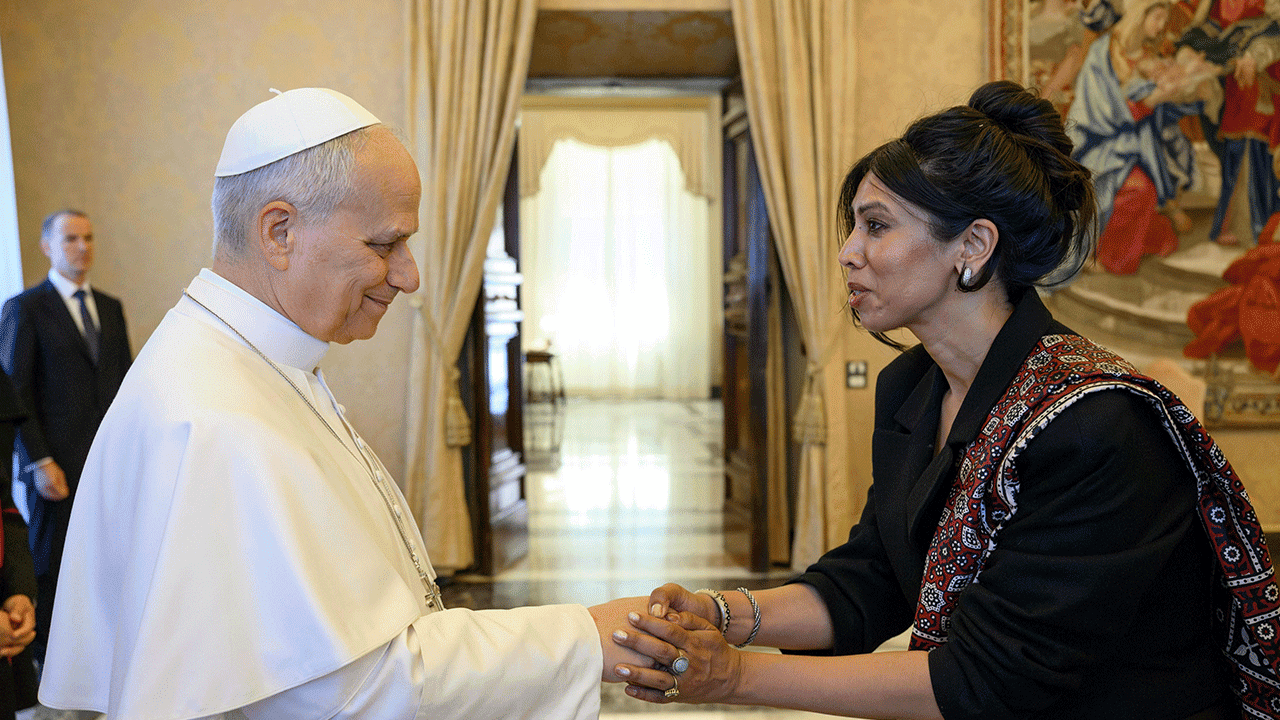
Last week, I had the honor of meeting Pope Leo XIV in person. I wore ajrak, the indigo block-printed cotton worn by the people in Sindh, Pakistan, for generations. Its patterns are thousands of years old, carried forward by hands that learned from hands across centuries. It is a record of human presence and human labor across time; it is the opposite of content quickly generated by a machine.
I wore it to remember, in that room, that the future does not erase the past. It is woven with it.
Six months before this encyclical, Pope Leo wrote that human beings are called to be co-workers in creation, not passive consumers of what machines produce. We agree. Our task is to make sure the loom stays open, so that the next pattern is woven by as many hands, in as many traditions, as possible.
That is the work. Over the next few months, we will share more ways you can be part of this work.
Executive Director
Mozilla Foundation