

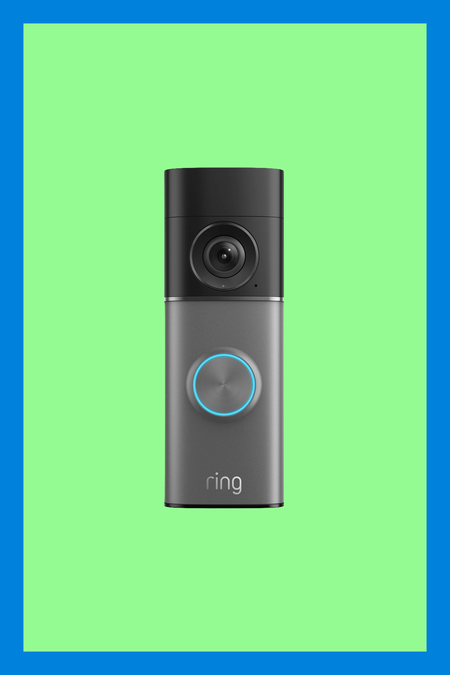



Ring Doorbell Pro Privacy Review
The Ring Doorbell Pro Gen 3 is not a privacy-friendly device. From the moment you boot it up, you are locked into Ring's entirely cloud-based service. There’s no option for offline use and no local storage of any kind. This is a significant limitation compared to other cameras in this space, several of which we've reviewed that do offer offline operation. Ring also has a well-documented track record of privacy failures, from employees accessing customer footage without consent to handing video to law enforcement without a warrant.
3/10
I’m a digital privacy and cybersecurity expert with over half a decade worth of experience reviewing privacy products. My research in academia included speculative execution attacks and AI-based hacking simulations. My privacy work appears in TechRadar, CNET, and ITPro, in addition to a previous stint at ProPrivacy as their in-house technical researcher for VPNs.
O que você deve saber
- Devo confiar nas configurações padrão?
-
The biggest issue with Ring's defaults is encryption. Video is transferred and stored using encryption, but end-to-end encryption (E2EE, the kind that would prevent Ring itself from accessing your footage) is not enabled by default. There is no mention of this distinction during the setup process.
Ring's default encryption is designed to protect your footage from unauthorized third parties, but not from Ring. Only by enabling E2EE do your recordings become genuinely private. However, enabling E2EE disables a substantial number of Ring's features, including shared accounts, person detection, facial recognition, 24/7 recording, pre-roll recording, and AI-powered video search. You are essentially choosing between privacy and functionality.
- Quais dados pessoais eles têm?
-
Ring collects your name, address, email address, and phone number at account creation. You may also provide your mobile’s geolocation if you consent at start up, although this is optional.
Setting up the Ring doorbell requires creating a Ring account and handing over your first and last name, your phone number for mandatory two-factor authentication, and the address where the doorbell is installed. Ring states the address is required so that its emergency response team can direct the relevant services (police, fire, ambulance) to your property if needed. We attempted to skip this step and found it is not optional. You cannot complete setup without providing Ring with your home address.
Video footage is stored on Ring's servers for a period you configure. Last we checked, that’s between 1 and 180 days for video, and 1 to 14 days for event snapshots. Ring states that footage is permanently deleted after this period, though its own privacy policy notes that deleted recordings may remain on Ring's systems for up to 72 hours after deletion is requested. You cannot retroactively change the retention period for footage already stored. Ring's own law enforcement guidelines confirm that Ring has access to your videos only if you have an active Ring subscription, including a free trial.
More broadly, you can assume most of your interactions with the Ring app are logged and monitored. A DSAR request by the BBC revealed that Ring captures a wide range of interactions with its ecosystem including when you remotely speak to visitors, when you zoom in on a video, and when someone rings your doorbell.
The thing we’re most worried about is Ring’s Familiar Faces feature. Essentially, it’s an AI-powered tracking system that allows Ring to figure out which person is in a video by capturing and comparing their biometrics. By Ring’s own admission, this biometric data is stored in the cloud.
- Histórico de avaliação
-
Ring's track record on privacy is one of the worst in the consumer camera space.
In 2023, the FTC charged Ring with a series of serious privacy violations covering the period from 2017 to 2020. According to the FTC's complaint, Ring deceived its customers by failing to restrict employees' and contractors' access to customer videos, using those videos to train algorithms without consent, and failing to implement basic security safeguards.
One employee spent several months viewing thousands of video recordings belonging to female Ring users taken from intimate spaces. Ring’s lack of oversight for accessing video recordings meant that this employee wasn’t caught until another Ring employee discovered their misconduct.
Ring also gave hundreds of Ukraine-based third-party contractors essentially unrestricted access to customer video. The settlement required Ring to pay $5.8 million in consumer refunds, delete data and algorithms derived from videos it unlawfully reviewed, and implement a mandatory privacy and security program.
Ring has historically maintained partnerships with thousands of police departments across the US, allowing agencies to request footage from users through its Neighbors app. Ring has reserved the right to share footage with law enforcement without a warrant or user consent in cases it determines involve imminent danger of death or serious physical injury. Amazon disclosed that it had done this 11 times in a single year.
In 2024, Ring discontinued the in-app Request for Assistance tool that had allowed police to solicit footage directly from users without a warrant. However, Ring's right to share footage without a warrant or consent under its own good-faith judgement remains in place.
- Este produto vende ou compartilha dados do usuário?
-
Ring does not sell your personal data in the conventional sense. However, enabling Ring's AI features gives Ring explicit permission to process your video footage.
Video can be shared with law enforcement via warrant or Ring's own emergency judgement. If you share footage voluntarily through the Neighbors app or a Community Request, Ring's own guidelines note that you lose control over where that footage goes. From their privacy policy: “Regardless of your use of a Subscription Plan, we retain recordings you share on Ring Neighbors if you choose to participate in the Ring Neighbors feature.”
Your video can be shared with other agencies, and you have no mechanism to request its deletion once shared.
Os aspectos positivos e negativos
- Os aspectos positivos
-
Ring does offer granular controls over motion zones and privacy zones during setup. One thing Ring does well by default: It opts you out of third-party cookies, analytics, and personalised advertising from the start.
You can request a full copy of the personal data Ring holds on you, and you can request account deletion. Ring does give you control over your video retention window, and if you do enable E2EE, footage should be genuinely inaccessible to Ring and to law enforcement.
- Os aspectos negativos
-
There is no offline mode. There is no local storage. There is no way to use the Ring doorbell in a meaningful way without Ring's cloud service, which means there is no way to use it that doesn't give Ring ongoing access to your footage under the terms described above.
Ring also updates its firmware automatically as soon as the device connects to WiFi, meaning Ring retains complete control over the device's behaviour at all times. The only defence against an unwanted firmware update would be to take the camera offline.
By automatically opting users into a 30-day AI Pro trial automatically, Ring ensures that every new Ring Doorbell starts up by sending cloud footage back to Ring for processing, regardless of whether you’ve made an informed decision about the subscription.
End-to-end encryption, the one meaningful privacy protection Ring offers, is buried behind a non-default setting that most people won’t even be aware exists. Worse, enabling it requires sacrificing most of the camera's features.
There’s also an unresolved question about how Ring’s E2EE implementation actually works in practice. Ring states that once enabled, only a device holding the decryption key can view footage. However, it's unclear whether that key is ever uploaded to the Ring device itself or their servers. If it is, the encryption is essentially pointless.
The company did not respond to a request for comment.
Reduza seus riscos
-
Enable E2EE if you can accept the feature trade-offs. It is the only way to put your footage genuinely out of Ring's reach. Set your video retention window to the minimum you can tolerate. Review the privacy zone features during setup and turn audio recording off.
Turn off Community Requests in the Neighbors app settings, too. Otherwise, you’ll receive requests from Axon Evidence in your Neighbors app asking you to hand over footage about incidents in your area.
As soon as you register your first Ring camera, you are automatically enrolled in a 30-day free trial. Your subscription to Ring can’t be disabled from inside the Ring app. Instead, you need to head to Ring.com and disable your account from there.
- Sign in to your account on ring.com.
- Select Plan on the top menu.
- Select the plan you want to cancel.
- Confirm cancellation.
Using Ring with any subscription means Ring most likely has access to your footage from the moment your camera turns on. You can enable EE2E, but not before the Ring camera starts phoning home.
Conclusão
-
Ring is a polished, capable doorbell camera that is also one of the most privacy-hostile products we’ve reviewed. The combination of mandatory cloud dependency, default non-end-to-end encryption, a documented history of employee access to customer footage and an ongoing relationship with law enforcement makes it a difficult recommendation for anyone who takes privacy seriously.
In January 2026, Nancy Guthrie was abducted from her home in Tucson, Arizona. She had a Google Nest doorbell with no active paid subscription, and the camera was disconnected during the abduction. Investigators were able to recover footage anyway from "residual data located in backend systems," and released images of a masked, armed suspect at Guthrie's door.
When asked about Ring’s own capabilities, Ring’s CEO Jamie Siminoff claimed that footage from Ring’s servers is deleted in “real time”. However, we’ve read that Ring's own privacy policy states that footage you delete may remain on its servers for up to 72 hours.
Whether it’s Ring or Nest, this is what you need to take away: Once your video has left your network and reached someone else's servers, you don’t own it anymore.
If you buy one, enable E2EE immediately, set the shortest retention period you can live with, and keep in mind that you are operating within Ring’s ecosystem on their terms.